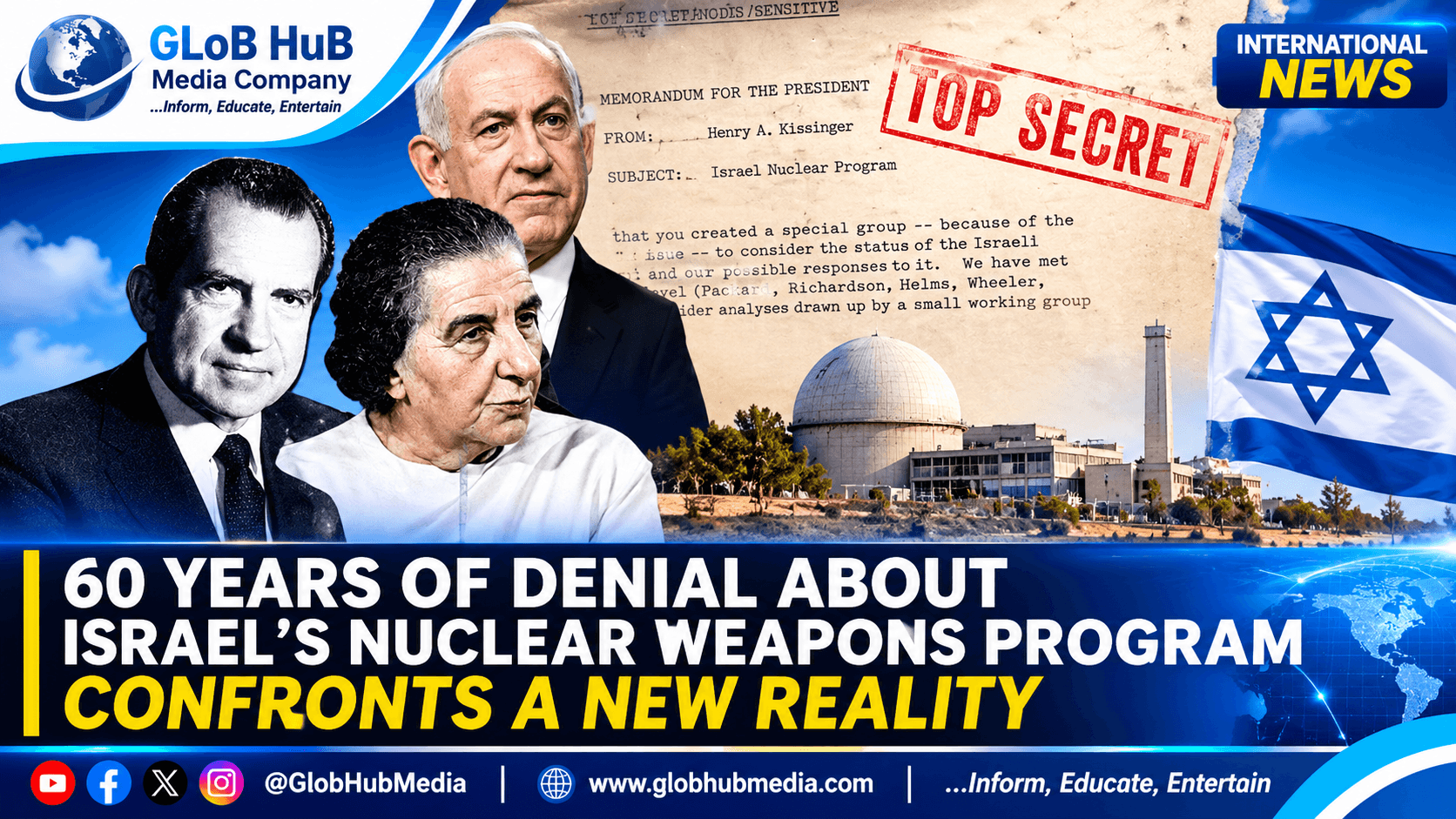
The history of the programme dates back to the early 1960s, when American diplomats travelling by helicopter over Israel’s Negev Desert noticed a major construction project near Dimona, west of the Dead Sea. When they asked an Israeli official about the site, he reportedly described it as a textile factory. American intelligence later identified it as a nuclear facility.
The Dimona facility became central to Israel’s nuclear programme. Declassified American documents show that Washington raised concerns about the site during the 1960s and sought inspections to establish whether it was being used for military purposes. Israel’s then Prime Minister, David Ben-Gurion, publicly maintained that the facility was intended for peaceful purposes.
Over the years, Israel developed what became known as a policy of nuclear ambiguity. The country has never officially acknowledged possessing nuclear weapons, while successive governments have avoided giving a clear public account of the programme. This position has allowed Israel to retain strategic uncertainty without making a formal declaration that it has joined the group of nuclear-armed states.
Although Israel has not disclosed the size of its arsenal, independent estimates indicate that it possesses nuclear warheads. The Stockholm International Peace Research Institute estimated that Israel had approximately 90 warheads as of January 2024. The figure is an external estimate, not an official Israeli declaration.
The issue has become more politically sensitive as the United States and Israel confront Iran over its nuclear programme. Washington has repeatedly stated that Iran must not acquire nuclear weapons, while critics argue that the international response exposes a contradiction because Israel’s own suspected arsenal remains outside the same level of public scrutiny. Israel’s nuclear status is also complicated by the fact that it is not a party to the Nuclear Non-Proliferation Treaty, unlike Iran.
The debate has reached the US Congress. Democratic Congressman Joaquin Castro has argued that Washington’s continued silence about Israel’s nuclear capabilities is outdated and potentially dangerous, particularly when American forces are involved in military operations alongside Israel. He has raised questions about Israel’s possible nuclear-use thresholds and whether the United States has contingency plans in the event of a nuclear escalation.
US Secretary of State Marco Rubio also addressed the issue during a congressional hearing in June. He acknowledged that most countries assess Israel to possess nuclear weapons, while noting that Israel has never publicly confirmed this. His remarks were described as among the most direct public statements by a senior American official on the subject.
There are also wider regional implications. The prospect of a nuclear cooperation agreement between the United States and Saudi Arabia has added another dimension to the debate. Some nuclear non-proliferation experts warn that openly acknowledging Israel’s arsenal could increase pressure on other Middle Eastern countries to pursue similar capabilities, potentially intensifying regional competition.

Khalil Ibrahim Yaro
Experienced journalist, Editor in Chief and media professional with a strong background in field reporting, investigative journalism, Editorial production, interviewing, research, digital media and newsroom coordination.
More from Khalil Ibrahim Yaro